Packaging & Presentation with Tyler Condon & Matt Boda
How Films Really Get Made: A From Page to Proof Reality Check
Independent storytellers are fed a lot of myths about how films actually get made. Win something, get great feedback, take a promising meeting and somehow that will be enough.
This From Page to Proof session cuts straight through that fantasy.
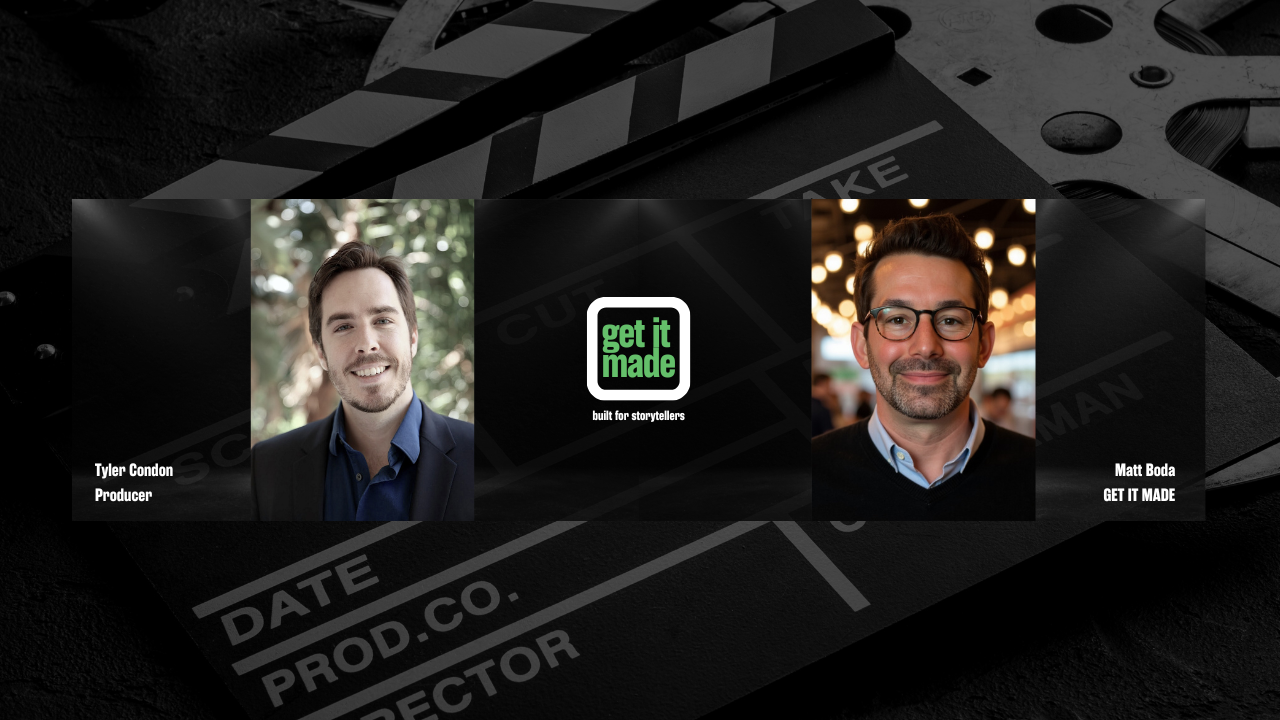
What follows is a recap of a live conversation between Matt Boda, CEO & Co‑founder of GET IT MADE, and Tyler Condon, a veteran producer who spends his days building real finance plans (equity, tax incentives, presales, and distribution) not hypotheticals. This is the part of the process most writers never hear explained clearly.
It’s the unglamorous business reality that separates projects that get financed from the ones that quietly die in someone’s inbox.
As Matt puts it bluntly:
“When you approach someone with only a script, you’re asking them to solve everything else (financing, packaging, and strategy) from scratch.”
And that’s usually where momentum stops.
If you don’t have time (or access) to watch the full replay, here are the essential takeaways every serious storyteller should understand about packaging, financing, and what actually moves a project forward.
Key Takeaways
1. How Producers Balance Market Reality, Taste, and the Script
Tyler makes it clear that he lives where market demand, personal taste, and a great script overlap.
On one side, he’s ruthlessly practical:
What are buyers actually looking for right now?
How have similar packages performed (genre, cast, budget, territories)?
Do the sales projections hit the benchmarks needed to justify a greenlight?
If the math doesn’t work, he won’t make the movie, no matter how much he likes it.
At the same time, none of that matters without a strong script. The screenplay is the foundation that makes it worth doing the work of packaging in the first place. A great script is what convinces him to invest time, relationships, and financial risk into a project.
His personal taste sits on top of that: the project has to be something he believes in creatively and wants his name on. But taste and enthusiasm only come into play after the script is solid and there’s a clear path to market.
2. Don’t Chase Trends
Tyler warns against writing and packaging just to match whatever seems hot right now. By the time you’ve finished the script, attached talent, and built a finance plan, the market appetite may have already shifted.
For example, if you suddenly decide to write a horror script because horror is selling this year, you’re already late. By the time your project is developed, packaged, and ready to take out, buyers may have moved on to a different flavor of horror—or a different genre entirely.
Instead of chasing the current wave, focus on:
A script that’s strong and specific enough to outlast short‑term trends
A package that still makes sense if the market has moved on by the time it’s ready to go
The goal isn’t to hit what’s hot this minute, it’s to build something that’s still financeable a few years down the line.
3. What Your Deck Really Signals About You
For Tyler, your deck is both a first impression and a mini‑production that shows how you think and work.
He looks at who’s in it (any real attachments or relationships) and who’s directing (is this someone who actually helps the package, or just a wish?). But he also reads the execution of the deck and your materials as a proxy for how you’ll handle development.
Two big red flags:
Sloppy design: blurry images, random fonts, clunky layout. That suggests you don’t really care how your project shows up or how professionals will experience it.
Wall‑of‑text, rigidly over‑explained materials: pages so dense and specific that it feels like there’s no room to shape the project together. That tells him you may not be very adaptable once real‑world constraints (budget, casting, buyers) come in.
This connects directly to the story Tyler tells about a writer who refused any changes for a buyer and ended up with a “perfect” show still sitting on their laptop. In his world, adaptability is a career skill: the projects that move are the ones where writers protect the core of their story but can still adjust to market, budget, and partner needs.
A good deck, in his eyes, is clean and focused with strong visuals, concise text, clear sense of the project while still leaving space for collaboration and evolution. As he puts it, “decks are production in itself”: a small but telling preview of how you’ll handle the bigger production you’re asking people to support.
4. Your First Real Attachment Is a Producer
Instead of calling CAA or chasing talent first, Matt and Tyler are clear that your most realistic first “attachment” is a producer inside the system.
Agencies are gatekeepers; they’re not going to build your project from scratch off a cold script. A good producer, on the other hand:
Turns your script into a package (producer + director + cast + finance plan)
Uses any equity you can bring as “ammunition” to get reads and attachments
Knows which agencies, talent, & buyers to approach and how
In their words, maybe the first call shouldn’t be to CAA at all, but to a producer you can approach with something real: a strong script, a clear lane, and whatever money or resources you can honestly put on the table.
5. The Package Drives Market Value (Especially for Pre‑Buys)
Tyler is explicit that the package, not just the script, is what creates market value—especially when you’re asking for pre‑buys or Minimum Guarantees (MGs) before production.
Buyers are looking at:
Who’s directing
Who’s producing
Who’s in the cast
What the realistic budget and finance plan look like
If those elements don’t add up to a package they can price and sell, they won’t advance money, even if the script is strong. The package is what tells them how big the film can be in the market and whether it’s worth betting on before it’s made.
6. Any Real Money You Raise Matters
Tyler stresses that any real money you can bring to the table changes the conversation. It doesn’t have to be the whole budget—family money, a small equity check, or a committed backer all count.
He gives the example of someone coming in with a script and saying they can put money toward the movie. That offer instantly gets more consideration than the same script with no financing attached, because:
It proves you’re serious and have skin in the game
It gives producers “ammunition” to hire a casting director and approach talent
It makes it easier to unlock more equity, debt, and pre‑buys
In a crowded market, a project with some real cash behind it will almost always get more attention than one that only has a script.
7. Hollywood Is a Closed System—You Need Partners Inside It
A big underlying truth in the conversation is that Hollywood is, in many ways, a closed‑door system. Access to talent, agencies, sales companies, and real financing largely runs through people who are already in the business and already trusted.
That’s why Matt and Tyler keep coming back to partnership:
Instead of trying to cold‑reach CAA or major actors, partner with a producer who already works with those reps.
Use whatever you can bring—great material, some equity, a clear lane—to meet someone inside the system halfway.
You don’t break in by staying on the outside and knocking louder; you break in by building with people who are already in the room.
9. Every Film Is a Startup
Every movie is its own business.
You have to form an LLC. Consolidate the rights. Paper the project. Make it real.
There is almost never one big check. Real finance plans are stitched together from multiple sources:
Equity (often including your own or your network’s)
Tax incentives
Debt against distribution
Presales and minimum guarantees
In-kind contributions structured as equity
A project moves forward when all of that reaches the strike price, the minimum budget that actually makes business sense.
10. The Hard Truth About First-Time Directors
This is where many projects quietly stall.
First-time directors are an uphill battle for distributors, for talent, and for financing. Many distributors won’t advance money without a proven director attached, and talent often passes (even on strong offers) if they don’t trust the creative leadership.
There are exceptions. But the default path is attaching experienced leadership first then earning the opportunity to direct your own work over time.